I sold my second book—a 120,000 word fantasy called Red Tiger—to Galleon, a small publisher in Canada last year, and it should hit bookstores later in 2026. The story begins when a 17-year-old karate prodigy from Nova Scotia, Galen Sinclair, wakes up after a horrible accident and finds himself in a medieval world facing a dark and perilous future.
Within his first moments in this new world, Galen meets Erasmus, a drunkard who claims to be a wizard, and later his manservant Mathias, who lives as a gentleman farmer after a long military career. I set up the story with these three characters, and realized that I had a huge problem. While we meet Mathias’s wife and daughters early, and they do have prominent roles to play, that comes much later in the book. The first pivotal female character, Ness—someone I couldn’t wait to meet—doesn’t appear until Chapter 10.
And so Dunstan, the seditious blacksmith in chapter five, became Dulcinea. I imagined Dunstan as short and powerful, quick to laugh, and ribald to a fault. And Dulcinea is all those things and more.
See what you think. I’d love to hear from you.
_________________________________________________
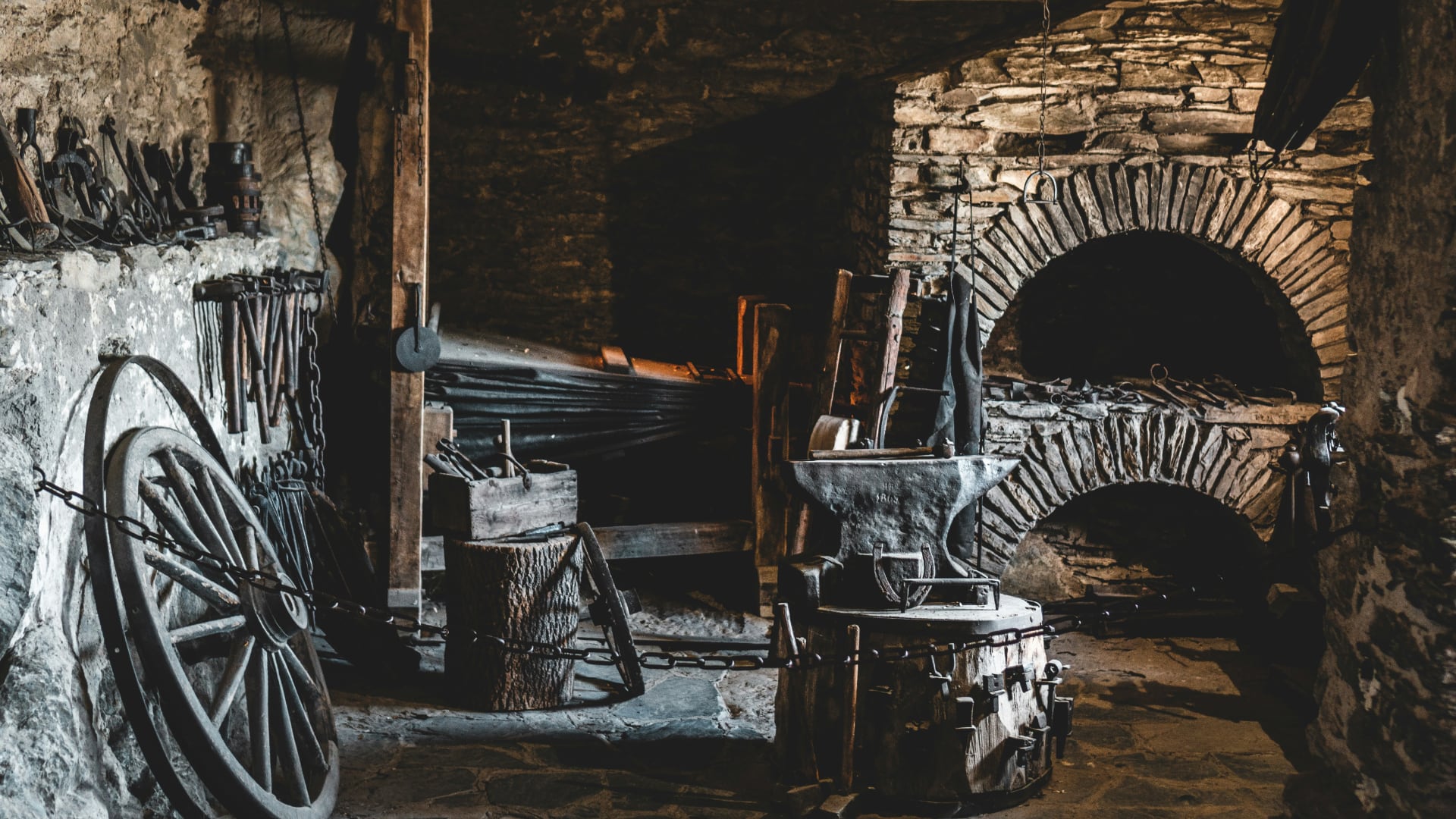
…They found the blacksmith along a dark, secluded lane. Galen didn’t know what he expected, but it certainly wasn’t a woman. Dulcinea greeted Erasmus and Mathias like old friends, clasping arms, and she welcomed Galen as a young master, her smile almost lighting the repressively dark forge. Two young men worked with her, like sons in face, though one was compact and the other a still-growing giant.
In manner, Dulcinea was exactly as Galen expected for her profession. She was nearing forty, and short, with close-cropped coal-black hair, and ears pierced with multiple rings. She was impressively fit, for her arms and shoulders rippled in waves, even when relaxed. Her clothes looked weighty with the dirt of her work, her heavy apron burdened by all manner of hammers and tongs, and she was covered in soot, so when her smile radiated across her face, it was like the brightest stars on an impossibly deep night. She found joy in her work, so that crooked grin was a nearly permanent feature.
“Might have known. When there’s mischief to be made, the two of you are like flies to shit.”
“Could you not have picked a more genteel comparison, Dulci,” Erasmus said. “Young Éamon, we need to teach your mother some manners. I’m sure her few scattered customers long for the day when you’re running things!”
“Oh no, good sirs, don’t wish for that—I still has much to learn.” Twenty-year-old Éamon, cut from the same short cloth as his mother, winked baldly, then fed the fire with huge shovels of coal.
“The boy has more sense of diplomacy than you do, Dulcinea.”
Dulci’s laugh was as natural and lively as the Alder, and it filled the room.
“That he does, Erasmus, that he does. How long you been in town?”
“Arrived last night. So we haven’t seen enough, and we’ve seen too much. What can you tell us?”
“The miserable truth. War is good for business, so the forge’s been running night and day, though I’ve only garnered a few dozen coins. Ulrik himself honoured us, agreed that I should mend swords and axes damaged in battle. He’s one crazy turd. Threatening my boys one minute, my best friend the next. He’s exhausting, but one of Jessamine’s was waiting, so his visit was short.
“Their steel doesn’t match our quality, but they use their weapons frightfully well. Shields are wooden, so the king’s men were better armed, but no match. From what I can tell, the grey-hairs lost maybe four dozen men and women—they let their women fight in battle which, I must say, seems a proper thing—and that many again suffered grievous wounds. King’s men at arms and bowmen are all dead, every blessed one, burned in a mass pyre last week.”
“Bloody hell,” Mathias whispered.
“Aye, the stench… I can still smell it.” Dulci looked shaken. “My pores absorbed a lifetime of sadness.”
That her pores had absorbed anything but soot and iron shavings over the last decade seemed doubtful to Galen, but her pain filled the forge just as her laughter had earlier.
“I fear for my family, my city, my kingdom. If reinforcements come, we’d need two thousand sturdy men to remove them. Maybe more.”
“We must move quickly,” Mathias agreed. “Enlist Prince Kenelm and the men of Greysport. They’ve always been allies of Aldsmouth, but we must reach them before winter.”
“Indeed.” Dulcinea pondered their words, as if weighing their chance for success. “What else do you need to know?”
“Have you seen their ships?” Mathias asked.
“Yes, six, a couple of miles south along the River Road. One left yesterday. Sleek and fast, by their looks, though I didn’t see them under sail. They have slaves. Dark men, twenty or so, as if from the legends.”
“They must be southern men,” Erasmus said. “The old stories speak of them, though I’ve met but a few in my travels. I wonder how the Stone Wolves captured them?”
“I cannot say, my friend, but they’re not long for this world,” Dulci said. “They’re hard used and poorly fed. If what you say is true, perhaps the coldness of our autumn nights is taking a bite, too. Can you help? Time is short.”
“I cannot see how,” Mathias said. “We’re but four, and I’m sure a few dozen guard their ships.”
Dulcinea was silent. Her sons, having stoked the blaze and readied the forge, stood quietly. They were powerful lads. The younger, Maximilian, was Galen’s age, but six inches taller. Both would be fierce fighters.
“In truth, I counted six. Though more may be hidden nearby. The prisoners are too ill to make mischief.”
“Well,” Erasmus rubbed his beard, eyes distant with thought. “That sounds manageable.”
Dulcinea’s smile returned, brighter than before
“Your weapons were confiscated,” Dulci said. “They’re thorough at the gates.”
“We brought none,” Erasmus said. “As our dress suggests, we are but humble merchants.”
Dulcinea laughed.
“Humble merchants, my arse! I can help. I have a single bow, and good steel hidden away. And there are quiet ways out of the city.”
“Well, that’s encouraging news,” Mathias said. “Perhaps a stroll along the River Road is in order, if your lads can see to our wagon.”
_________
My impressions of a smithy were informed by a day spent with John Little, in Dover, Nova Scotia. He dropped out of grad school in the 1970s to forge a career as an artist in a small hamlet by the Atlantic Coast. At the time, he was better known in the Big Apple than in Nova Scotia because The New Yorker profiled him because he created the armature that supported a Tyrannosaurus Rex skeleton at the American Museum of Natural History.